Building Muscle Memory for a Lifesaving Moment
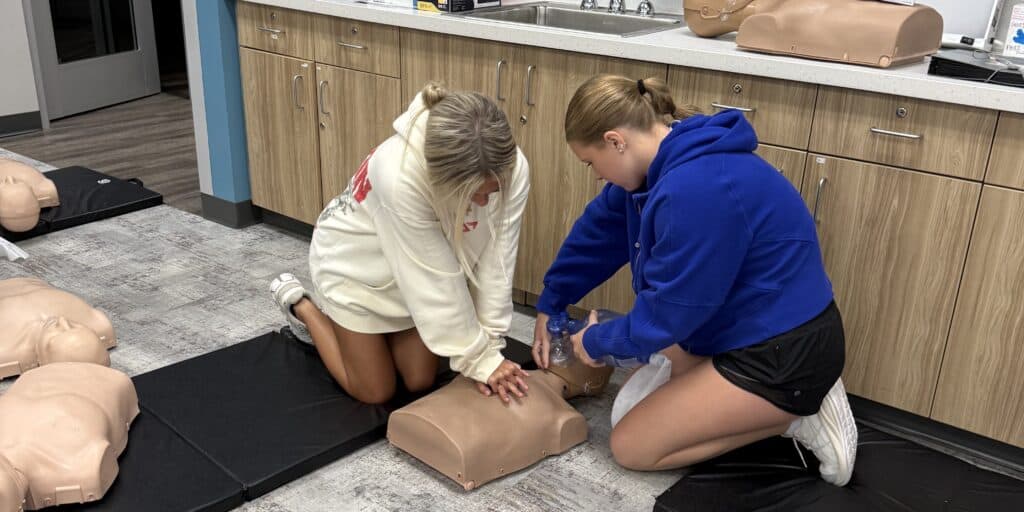
 Those who save lives through CPR don’t get an email or text informing them that “today is the day.” The emergency could come at any time.
That’s why instructors at Empower College and Career Center want their healthcare students so well trained in the skill that the movements feel second nature in a crisis.
“We want to train muscle memory so that in the moment that they’re to need to perform CPR, they’re not having to think as much as their body just knows what to do,” said Lisa Cauthen, Empower’s healthcare department chair and phlebotomy instructor.
This school year, a $1,512 HireSmart Cares grant is helping more of those students leave with proof of their training. The grant pays for American Heart Association Basic Life Support certification cards for students who pass a written exam and a hands-on skills check. It’s intended to cover approximately 275 juniors and seniors during the 2026–27 school year.
CPR has long been part of the healthcare coursework at Empower. Students who wanted the certification card, however, had to pay $5.50 for it themselves, and not all of them did.
“For some kids, it’s cost prohibitive,” said Maggie Brown, who teaches allied health. “It gets some of those kids who maybe wouldn’t be able to pay for it out of pocket to be able to get those certifications that they worked really hard for.”
The certification is one piece of a larger healthcare program at Empower. Students there can take advanced courses in allied health, phlebotomy, pharmacy, emergency medical response, mental health, and biotechnology.
Some students try as many as they can fit. Brown has watched students finish allied health with her and move on to phlebotomy, pharmacy or emergency medical response with her colleagues.
“We do have some students who take most, if not all, of the third-level offerings,” Brown said. “They’re super interested in it.”
Others arrive with a career goal and focus on one specialty. But demand has grown enough that a science teacher has taken on anatomy instruction, and mental health joined the course offerings this year.
Empowered healthcare teachers are certified American Heart Association instructors. In class, students practice chest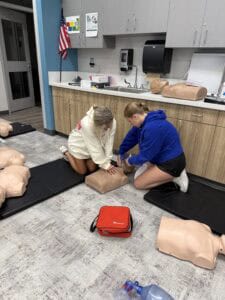 compressions, rescue breaths, and automated external defibrillator use, and they learn what each member of a response team is supposed to do.
Catie Lees, who teaches emergency medical response, approaches the material from the perspective of a responder working outside a hospital. Katie Crowe, who teaches pharmacy operations and fundamentals, said the teachers explain why chest compressions must reach the correct depth, why the chest must recoil between compressions, and why early AED use matters. She said students respond to the hands-on instruction.
“I’ve always seen that students are really engaged with it,” Crowe said.
For students headed into healthcare, the certification card gives them something concrete to show an employer. Cauthen said earning it before graduation can give them an advantage when applying for jobs.
“When you look at a healthcare job application, it will say BLS required within one year of employment, and these students will already have that,” she said. “So that’s one less thing that the employer has to take time to teach them, and it shows that these students had incentive to go ahead and get it and earn it.”
The call for life-saving help can come at any time and any place. And now, thanks to Empower and its instructors, Jackson County has more lifesavers equipped for the task.
To learn more about Empower, visit empower.jacksonschoolsga.org.
To learn more about HireSmart Cares, visit hiresmartcares.org.