Banks County Students Take Their Skills to a Welding National Championship
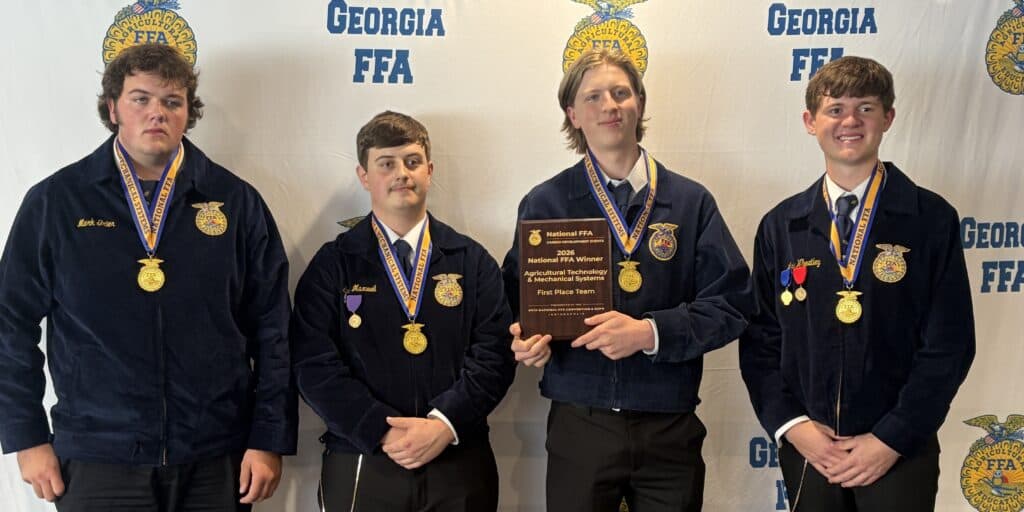
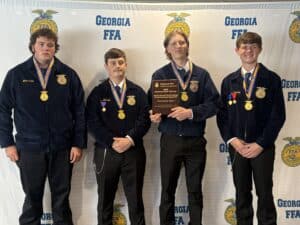 First. Second. Fourth. Seventh. Banks County High School’s four competitors each claimed a place among the nation’s best at the national FFA Agricultural Technology and Mechanical Systems competition, bringing home the team championship in a field of 46 teams.
Ty Miller placed first individually, Luke Wheatley finished second, Mark Grier placed fourth and Luke Maxwell placed seventh. Agriculture mechanics teacher Chris Crump said the event tests technical knowledge through written testing, practical activities and team problem-solving.
The students prepared for months, advancing through area and state competitions before turning their attention to nationals.
“We definitely dedicated a lot of time to it,” Miller said.
For Crump, the result brought relief. He knew students had gained valuable skills, but he had worried they might struggle to appreciate that if they didn’t win.
“For me, the cool thing was knowing their hard work didn’t go to waste,” he said.
Having the Tools to Prepare
The students’ success was aided by a $7,001.64 grant from HireSmart Cares that helped them prepare, while also upgrading the school’s agriculture mechanics shop for future classes.
The grant funded a Lincoln multiprocess welder, a Lincoln 65-amp plasma cutter, and 35 flame-resistant welding jackets.
Crump said the plasma cutter was a huge addition. The shop’s existing cutter was attached to a computer-controlled CNC system, so the students couldn’t remove it to practice handheld cutting, a skill required in the national team activity.
“Having that just for the contest was invaluable because we could actually practice one of these skills for nationals,” Crump said.
Miller said the new equipment made a big difference.
“Having the plasma cutter and all that practice time helped us so much,” he said. “I feel like having that prior experience and knowing what we were doing really helped us get that win.”
The welder gave students experience with newer technology in a compact machine. Existing welders were older or oversized for the work students were doing. The new machine also happened to resemble the equipment they encountered at nationals.
“It was actually a good coincidence, but it was a great help to prepare for it,” Crump said.
In his grant application, Crump described outdated machines, some no longer operational, that limited practice opportunities. The protective jackets needed replacing, too. Some were more than 20 years old, with tears and broken buttons.
More Skills and More Options 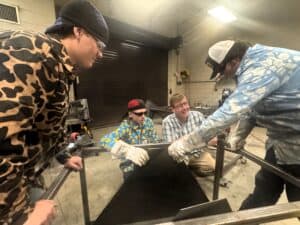
Other students are learning on the equipment as well. Crump said a class recently completed its plasma-cutting unit, practicing with the new cutter alongside an oxyacetylene torch and learning when each tool is useful.
That experience means students can enter a fabrication shop already familiar with equipment they may be asked to use. Crump said familiarity also helps them work more safely.
“Job-wise, it just makes them so much more versatile,” he said.
Grier, a senior, said access to practical instruction gives students an advantage.
“It’s just really good to have the ability to do anything hands-on,” Grier said. “A lot of people don’t have that opportunity unless it’s out of school. That puts you a step ahead of a lot of people.”
For Miller, learning welding and fabrication complements an interest in another trade.
“I’m definitely interested in trade jobs in general, specifically electrical. That’s kind of my thing,” he said. “But honestly, the more I learn and the more skills I have, the better. You’ve got more options.”
Maxwell is already applying his training. Crump said the national team member works at Chris Ashworth’s machine shop while attending machine school. The business also does fabrication, giving him opportunities to use skills he practiced in class.
Seeing What They Can Do
Crump deflects attention when asked about whether it’s personally satisfying to have coached up four top 10 finishers in his program at the national level. He said the accomplishment is the work of the students and their dedication to learning. He said the competition provided evidence to his students of their progress.
“They got to see what they learned actually was useful, and it translated to success,” he said.
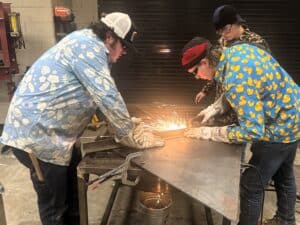 A younger group, including 10th graders, is now developing welding skills, and the new equipment will be available as those students prepare for competitions and consider what they might want to do after high school.
Crump wants the younger students to recognize that many opportunities are ahead.
“They just need the motivation and a push that way,” he said.
To learn more about HireSmart Cares, visit hiresmartcares.org.