HireSmart-funded Drone Program Helps Careers Take Flight
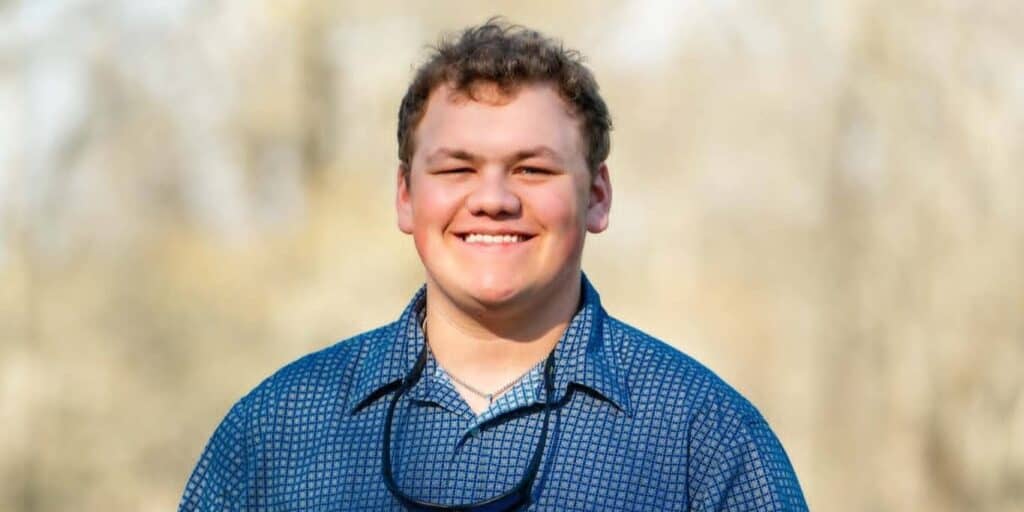
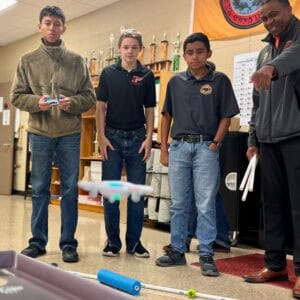 Zachery Hess has a skill most aspiring graphic designers don’t. He can fly.
Hess is the outgoing drone commander for the Navy JROTC program at Pisgah High School in Canton, North Carolina, where instructor J. Scott Campbell built a competitive drone program with help from a $4,981 HireSmart Cares grant. This fall, Hess heads to East Tennessee State University to study graphic design and multimedia.
“Thanks to HireSmart Cares, Pisgah NJROTC was able to build a competitive drone program from the ground up,” said Hess. “We are truly grateful for your donation and helping our drone team get off the ground. Pun intended.”
Campbell knows something about getting footage from above. He spent 23 years in the Navy as a photojournalist, flying in jets and helicopters to document military operations. On September 11, 2001, he was aboard the USS George Washington when the attacks unfolded. An admiral placed him in a helicopter over New York and granted him a field Top Secret clearance on the spot. The photograph he took that day shows the carrier positioned off the coast of New York, smoke from the collapsed towers rising in the background.
When Campbell retired, he became a JROTC instructor. He’s been at Pisgah for three years.
“I was like, man, I’m still molding lives and changing lives,” he said.
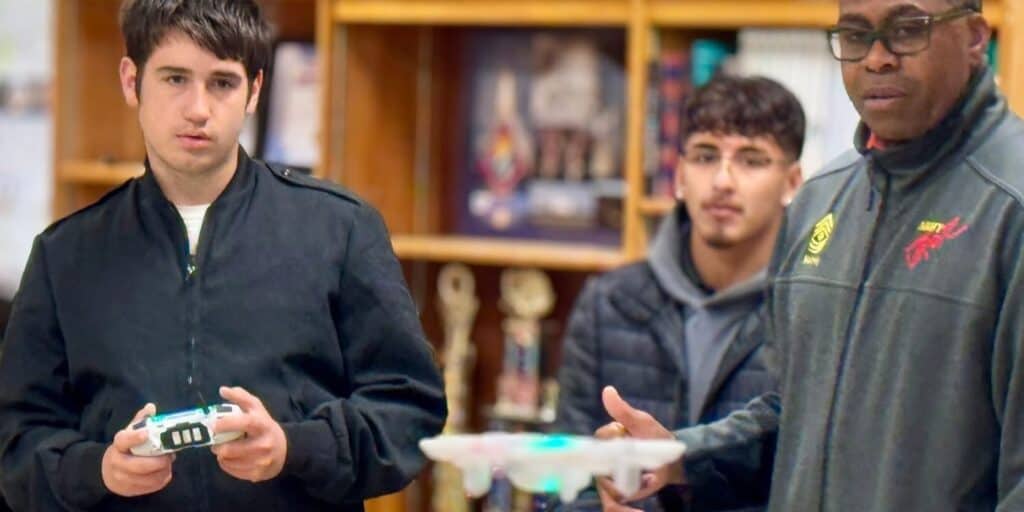
Drones were a natural fit. Campbell used the grant to purchase competition drones and camera drones, then opened the program to the entire school, not just JROTC cadets. He taught all 85 cadets to fly and held competitions against four or five other schools. Events ran through the gym and spanned two full buildings, with names like the Running Man and the Gauntlet.
“The kids were 100% engaged, and it was awesome,” Campbell said.
Part of what drove that engagement was the moment students realized what they were actually flying. Everyone had handled a cheap toy drone before. These were different. Once students saw the sensors and gyroscopes, once they understood they could navigate obstacles with precision, something shifted. 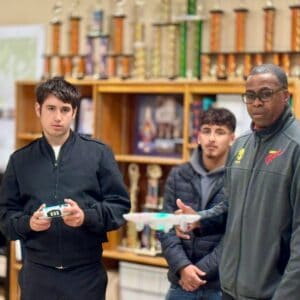
“Once they learn that it’s not those [cheap drones], and they have sensors on them, and gyroscopes that help keep it balanced, they were like, OK, this is something I’m capable of doing,” Campbell said. “Once they realize they can actually do it, they’re like, wow, I like this. OK, this is cool.”
Campbell also purchased camera drones with the grant and uses them to shoot music videos for the cadets, posted to the school’s Facebook page. The footage, he told students, represents something a videographer on the ground simply can’t produce.
“I was showing them how much it pays in the real world to have a 107 license,” Campbell said. “It pays big dog money for that.”
The grant application outlined ambitions beyond competitions, including aerial scavenger hunts, search and rescue missions, and nighttime operations. The goal running underneath all of it is the FAA Part 107 remote pilot license, which qualifies holders for commercial drone work. Campbell plans to run a three-day Part 107 training course this summer during new cadet orientation and expects 25-to-30 students to pursue licensure. He projects 295 students will benefit from the grant overall, with at least 225 per school year going forward.
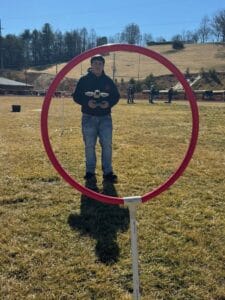 Hess is the program’s clearest example of where that path leads. Campbell has watched him develop from a cadet learning to fly into the drone captain who shoots footage at drill competitions that nobody standing on the ground could capture. When Hess graduates, incoming freshman Caleb Norman takes over as drone commander, a handoff that signals the Flying Jaguars program has a life beyond the students who built it.
Campbell said the school does not fund the JROTC program the way it funds other activities, which makes outside grants like HireSmart’s essential.
“They don’t give us any funding like they do football or anything like that,” he said. “For y’all to hook us up with the $5,000 like that, that was just amazing, and it helped us to be able to open up something that we didn’t have before and open the kids’ minds up a little bit more than what they were.”